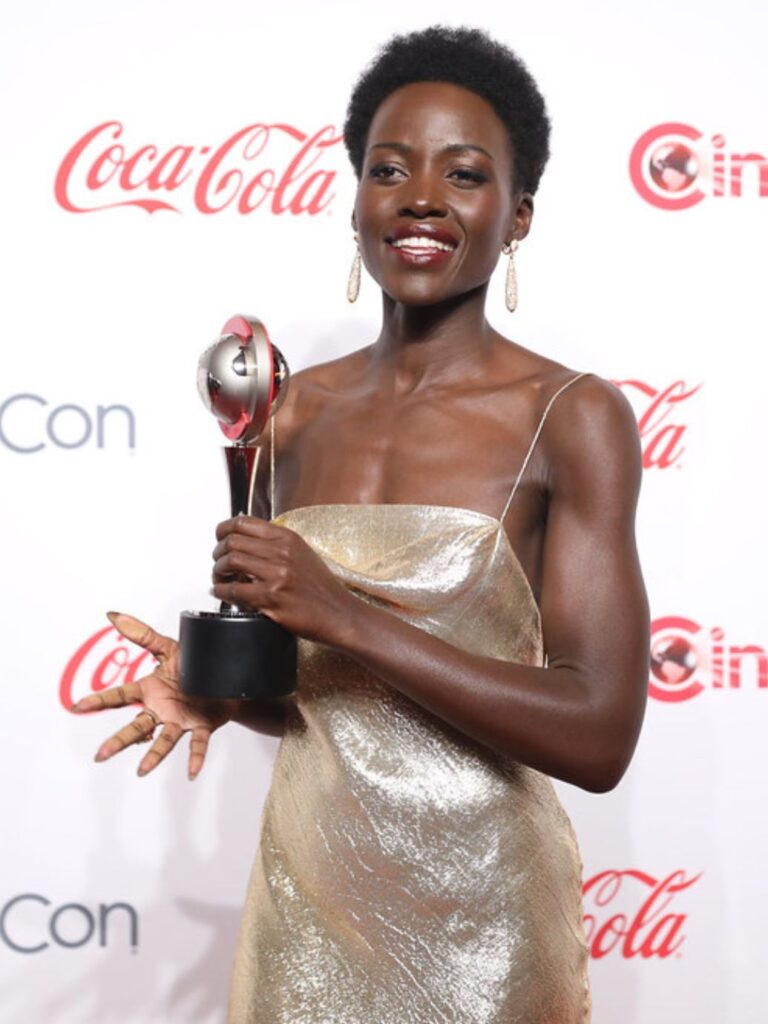
In a landscape often paralyzed by the fear of “too much”—too bold, too bright, too textured—Lupita Nyong’o didn’t just enter the room; she illuminated it. When we examine the narrative of 21st-century style, she is not merely a participant; she is a protagonist who rewrote the rules of color and presence. For a fashion consultant, analyzing Nyong’o is like studying the fauvists; she is the foundational text on the joy of visibility.
Her style journey began by shattering the antiquated rulebook regarding what women of deep complexions “should” wear. Emerging in an industry that frequently relegated dark skin to muted earth tones or “safe” neutrals, Lupita was a revelation. She possessed an athletic grace, a radiant complexion, and a carriage that felt regal without being rigid. Instead of shrinking into the background to placate a conservative gaze, she treated her skin not as a limitation to work around, but as a canvas that demanded the highest saturation. She didn’t just wear color; she weaponized it.
This philosophy was immortalized in her breakout “Nairobi Blue” Prada moment at the Oscars. It is arguably the most significant color story in modern red carpet history. When she stepped onto the carpet, she wasn’t just wearing a gown; she was reclaiming a narrative. The pleated chiffon in that specific, custom shade of blue didn’t overpower her; it worshipped her. The deep V-neckline and the fluidity of the skirt were strategic choices to highlight her strength and her softness simultaneously. This is the first lesson I take from Lupita: style is not about dilution; it is about finding the frequency that makes you vibrate.
Beyond the dizzying heights of her red carpet couture, Lupita’s true legacy lies in her architectural approach to beauty, specifically through the medium of her hair. She championed the versatility of Afro-textured hair long before the “natural hair movement” fully seized the mainstream luxury space. Think of her sculptural updos, her intricate braids, and her regal headwraps. She treated hair as a crowning accessory, defying the Eurocentric gravity that often dominates Hollywood. She proved that texture is structural, elegant, and high-fashion, demonstrating that you don’t need to alter your biology to achieve sophistication.
Lupita also taught us the power of “kinetic” dressing. Her aesthetic is defined by movement. She chooses garments that live and breathe—capes that billow, skirts that twirl, metallics that catch the light. She avoids the stiff and the static. When she wears a garment, she interacts with it. That famous twirl in the red Ralph Lauren cape dress at the Golden Globes wasn’t just posing; it was a declaration of joy. This vitality is what makes her images arrest you. A stiff gown looks like a costume; a moving gown looks like a memory.
For my clients, the “Lupita approach” is often the most liberating because it requires the courage to say “yes.” It requires saying yes to the color that scares you, yes to taking up space, and yes to the texture you were told to hide. It is a philosophy of celebration—treating clothing not as armor to protect you from the world, but as a medium to introduce yourself to it.
Ultimately, Lupita Nyong’o’s style is a triumph of joy over conformity. She inhabits the clothes; she animates them. Whether she is stunning in a structured Versace chainmail or radiating in a simple, vibrant sundress, she projects the same level of sovereignty. She taught us that fashion is not about blending in. It is about turning the volume up on your own existence. In a dull world, that fearless saturation is the ultimate luxury.