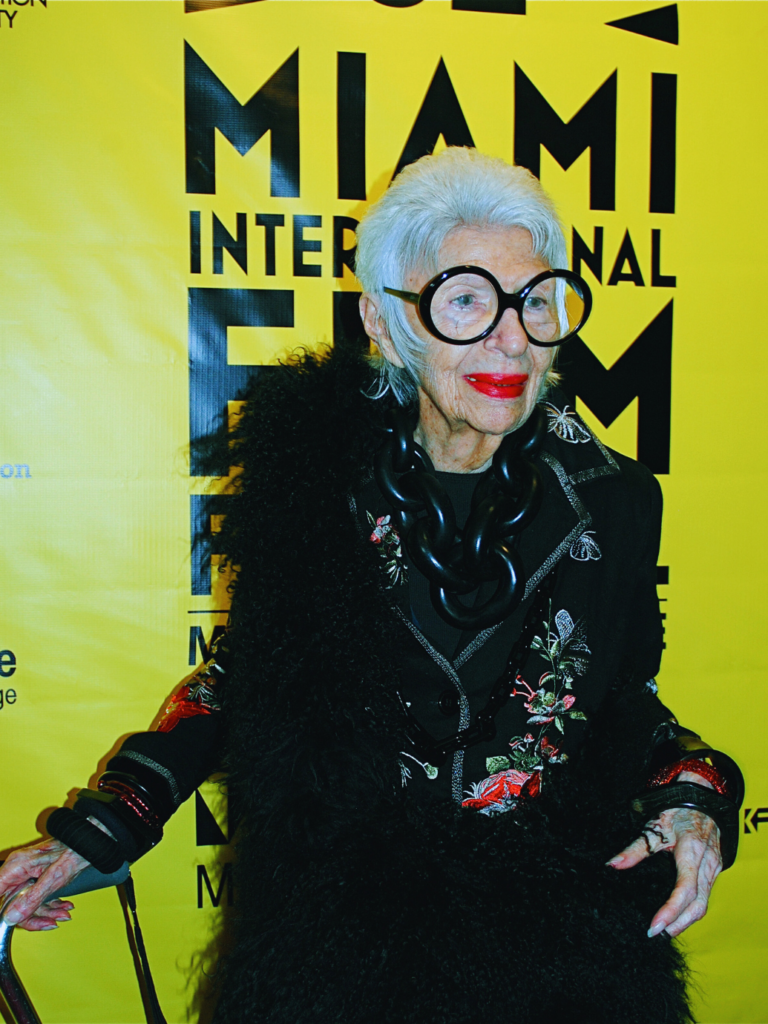
A high priestess of the maximalist rebellion. With her owl-round glasses, layers of chunky turquoise jewelry, and kaleidoscope of fabrics, Iris smashed the invisible rulebook that tells women—especially older women—to fade into the background. She didn’t just dress; she curated a spectacle. For anyone who feels stifled by the “rules” of fashion (don’t mix patterns, take one accessory off, dress your age), Iris Apfel is the antidote.
Born in Queens in 1921, Iris was never a fashion insider in the traditional sense. She was a businesswoman and an interior designer who, along with her husband Carl, founded Old World Weavers. She spent decades traveling the globe, sourcing rare fabrics for clients that included nine different presidents at the White House. This background in textiles is crucial to understanding her style. She approached her body like a room that needed decorating—mixing textures, eras, and provenances with a fearless eye. She understood that a piece of fabric from a flea market in Morocco could sit next to a Versace jacket, provided the color story sang.
Iris famously declared, “I’m not pretty, and I’ll never be pretty, but it doesn’t matter. I have something much better. I have style.” This distinction is profound. “Pretty” is genetic; it is passive. “Style” is active; it is a muscle you build. Iris taught us that style is a creative endeavor, a form of play that keeps you young. She rejected the idea that fashion was about looking “good” for other people. For Iris, fashion was about entertaining herself.
Her philosophy of “More is More” wasn’t just about clutter; it was about composition. She was a master of layering. She would stack bangles up to her elbows, treating jewelry not as an accent but as armor. She mixed high and low before it was trendy to do so, pairing haute couture coats with denim jeans and costume jewelry she bought for pennies. She proved that the price tag of an item has zero correlation to its coolness. A plastic bracelet could be just as valuable as a diamond one if it had the right shape and color.
What I love most about Iris is her improvisational spirit. She didn’t use a stylist. She didn’t plan outfits weeks in advance. She stood in front of her closet and played jazz. She described the process of getting dressed as an adventure, often better than the party she was going to. This is a lesson I try to impart to my clients: we often treat getting dressed as a chore or a test we have to pass. Iris treated it as an art project.
Her rise to global fame came late in life, in her 80s, when the Metropolitan Museum of Art’s Costume Institute staged an exhibition of her wardrobe titled Rara Avis (Rare Bird). It was the first time the museum had ever showcased the wardrobe of a living woman who wasn’t a designer. The world fell in love with her not just because she looked cool, but because she represented freedom. In a culture obsessed with youth and perfection, here was a woman with grey hair and wrinkles, looking more vibrant than a 20-year-old model.
Iris Apfel reminds us that aging is not a slow fade to beige. It is an opportunity to become more of who you are. She refused to be invisible. By wearing bright colors, massive prints, and those signature glasses, she demanded to be seen. She taught me that you don’t stop having fun with fashion when you get old; you get old when you stop having fun with fashion. Her legacy is one of joy, curiosity, and the unshakeable belief that being interesting is far more important than being perfect.